Steady first half year for Port Otago
Port Otago today announced a half-year profit of $13.7 million for the six months ended 31 December 2025 – 9% down on the comparable 2024/25 result of $15.2 million.
Port Otago Chair Tim Gibson said that, although the profit figure is slightly behind last year, the contribution from operating activities of $18.8 million is up 21% on last year’s $15.5 million result. “This $3.3 million lift was due to increased revenue and flat operating costs.
“On the revenue front, bulk cargo was the stand-out performer for the six-month period. Volumes were up 26%, largely due to a 42% lift in log export volumes to more than 650,000 tonnes. Log exporters responded quickly to manage windthrown trees from storm events, assisted by stable demand from Chinese and Korean markets.”
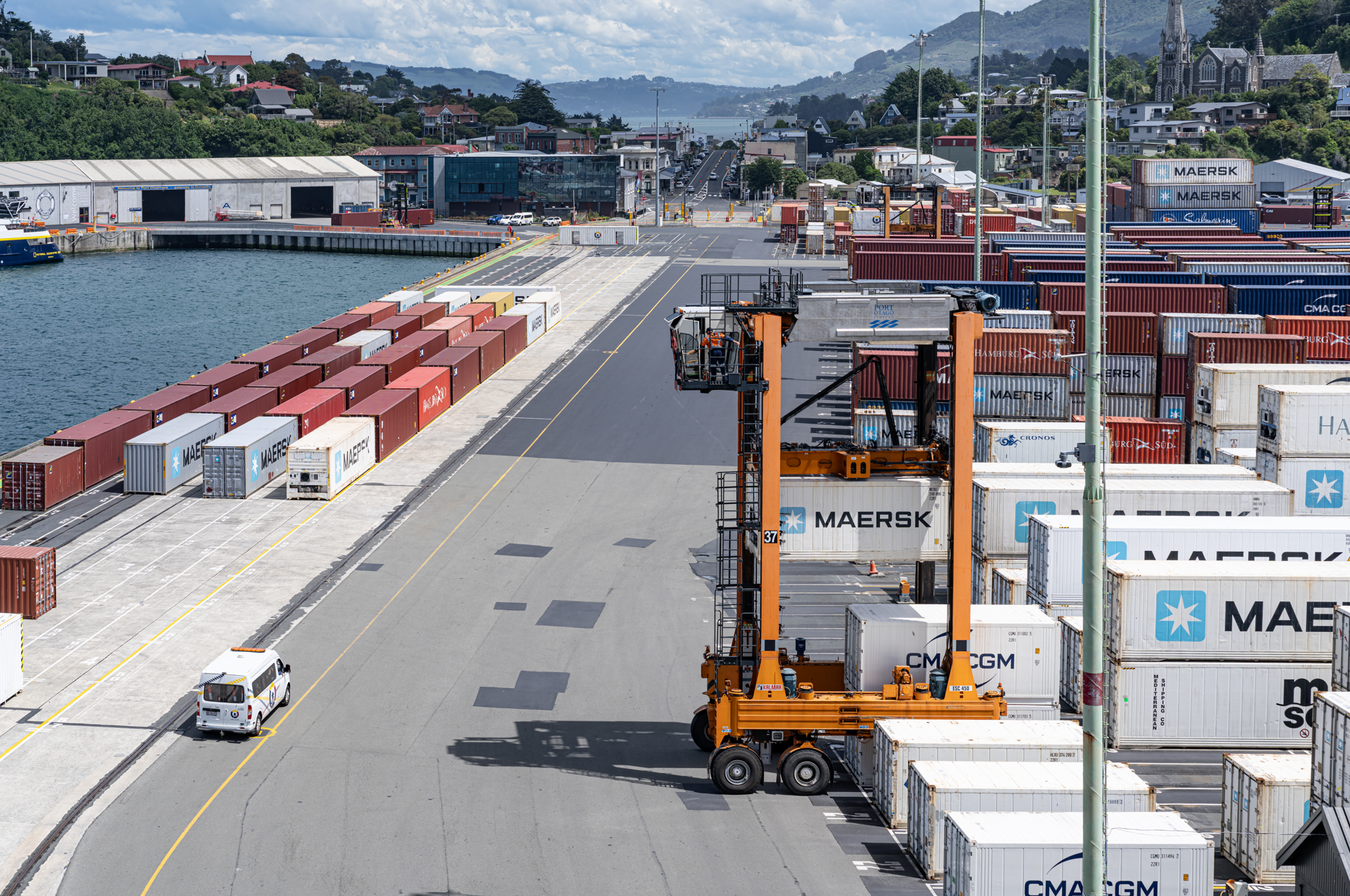
Container volumes were flat at 113,600 TEU, although full import and export volumes were up 3% on the same period last year.
Property rental income from the Auckland, Hamilton and Dunedin property portfolio increased 8% to $21.5m.
Mr Gibson said returns from the cruise business unit were down the most dramatically, with only 18 vessel arrivals, compared to 26 for the same period last year. “This 31% decrease in ship numbers impacted the bottom line and reduced the valuable cruise-related economic benefit to Dunedin City and the wider Otago region.”
The result included one-off gains from the sale of property assets of $2.0 million, down $4.4 million on the $6.4 million for the same period last year.
For the first time in the port company’s history, Port Otago’s assets were valued at more than $1 billion at 31 December 2025. The equity ratio was 77%, while borrowings increased by $7 million over the six months, to $171 million. This is related to the large capital investment underway in both marine plant and landside developments to accommodate future demand.
Investment over the period
Mr Gibson says the six months to 31 December 2025 included significant steps towards the “always open” strategy, which relies on the port’s ability to handle the larger ships of the future and ensuring our harbour defences are capable of withstanding the increasing number of extreme weather events.
“Our project to deepen the Lower Harbour to 14 metres is largely complete, while engineering solutions to improve the resilience of the Aramoana mole are well advanced. And, as of last week, our new $15 million Damen 2312 Tug Ōtepoti has arrived in Port Chalmers. She provides the second 70-tonne bollard-pull tug required to manoeuvre 10,000 TEU ships when they arrive.”
In October 2025, the new $12.5 million Port Chalmers Container Terminal rail pad was completed, as the enabling stage of the inland port project, Southern Link, at Mosgiel.
The following month, Port Otago sold its dairy logistics business on Back Beach Road to Fonterra and signed a 35-year lease on the 34,000m2 warehouse, allowing the co-operative to operate and control both the Mosgiel and Port Chalmers stores.
Looking ahead
For the six months to 30 June 2026, Mr Gibson said container and log volumes looked particularly positive. “The wet spring and summer across our region have boosted grass growth and we expect higher volumes of meat and dairy products to flow through our container terminal in the second half of the financial year. Meanwhile, our forestry customers continue working through the clean-up of windthrown trees, potentially resulting in a 10% greater volume through our Dunedin Bulk Port and Port Chalmers log yards.
“Continued geopolitical uncertainty and impacts on trade lanes remain a disruption risk for New Zealand imports and exports, but we are prepared to adapt and change, so we can be always open.”
Demand for new warehouse builds in Hamilton and Auckland remain subdued. “However, our underlying investment portfolio is 99% occupied and we are achieving positive market rental uplifts, due to the relative higher cost of new build alternatives.”
Mr Gibson said that, as a business, the port’s balance sheet remains conservatively geared. “This leaves us well positioned to take advantage of opportunities as they arise. It is appropriate to acknowledge this strong position, while we continue focusing on our strategy of being New Zealand’s always open port.”
Directors declared an interim dividend of $10.0 million – up from 9.0 million last year – which will be paid on 19 February 2026.